

If you’ve ever wondered, “Why won’t my brain turn off, even when I’m resting?” after a long day of taking care of everyone and everything, you’re not alone in that experience.
The children are finally settled for the evening.
You’ve handled what needed your attention, changed into something comfortable, and settled onto the couch.
You’ve been looking forward to this quiet moment all day.
But your mind is already thinking about tomorrow’s schedule, what to make for dinner, the appointment you still need to reschedule, and the goals you’ve barely had time to think about.
You reach for your phone, hoping it will give your mind something else to focus on.
Before you know it, an hour has passed.
Your body has been still, but your mind hasn’t had a chance to settle.
And now you’re wondering whether you should have used that time to get something else done.
Here’s something worth remembering: Having free time is not the same as having mental space.
If you’re already recognizing how much your mind is carrying, my free Soft Life Prescription™ mental overload reset offers a guided space to begin exploring what’s weighing on you.
But first, let’s understand why resting doesn’t always feel restful.
🌿 Resting, but Still Mentally “On”?
If your body is finally resting but your mind is still running through tomorrow’s responsibilities, unfinished tasks, and everything you need to remember, you may need more than a physical break.
Start with The Soft Life Prescription™, a free 15-minute guided reset that helps you unload your thoughts, identify what’s taking up mental space, and find a gentler next step that fits your capacity.
Why Won’t My Brain Turn Off? Understanding the Mental Load of Motherhood
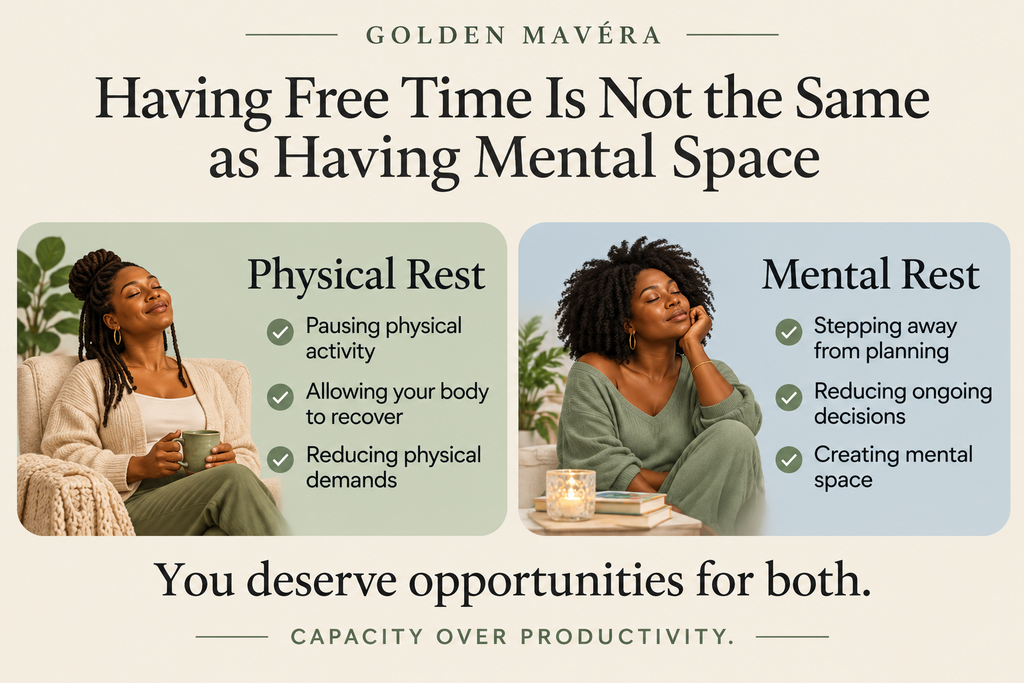
Resting your body doesn’t always mean your mind gets to rest, too.
You might be sitting down, watching television, or enjoying a quiet house while still planning, remembering, and making decisions in your head.
That’s the difference between physical rest and mental rest. Your body has stopped working, but your mind is still managing things.
As a mother, your responsibilities often extend beyond the tasks you physically complete.
Consider something as ordinary as doing the laundry.
Doing the laundry is one task. Remembering that your child needs a clean uniform tomorrow, checking whether there’s enough detergent, and making sure the clothes actually make it into the dryer are several more.
Now add school schedules, meals, bills, work, appointments, and everything you’re trying to do for yourself.
That’s a lot to keep track of, even when you’re not physically doing anything.
Suddenly, a relatively quiet evening may still contain a considerable amount of mental activity.
This invisible mental labor is part of the mental load of motherhood.
When you’re continually responsible for remembering, anticipating, organizing, and responding to everyone’s needs, that mental responsibility doesn’t necessarily disappear when you stop moving.
When you’re responsible for keeping track of so much, even small decisions can start to feel exhausting.
You might find yourself getting irritated more easily, forgetting little things, or struggling to enjoy the quiet moments you’ve been waiting for all day.
It doesn’t necessarily mean you’re doing something wrong. It may mean you’re carrying more than your current capacity can comfortably hold.
Sometimes, what you need isn’t simply more time to rest, but less responsibility to mentally manage during that time.
Why Unfinished Responsibilities Stay on Your Mind
Imagine trying to enjoy your evening while simultaneously remembering that your child’s permission slip needs signing, your car needs an oil change, and an important work email still requires a response.
None of those responsibilities necessarily requires your attention at that exact moment.
Yet each one may continue occupying mental space.
When your mind is the only place you’re keeping track of everything, it’s hard to fully switch off.
You keep reminding yourself about unfinished tasks because you’re afraid you’ll forget them. And every new responsibility gives you one more thing to remember.
This is one reason mental exhaustion in mothers isn’t always accurately reflected by how much they’ve physically accomplished.
You may have spent an hour sitting down while mentally navigating an entire household’s needs.
This is where the Soft Structure™ Method offers a gentler way forward.
Instead of asking, “How am I going to get everything done?” try asking, “What actually needs my attention right now?”
Some responsibilities belong to tomorrow.
Others could be shared with someone else.
Some may not need to be carried at all.
Recognizing these differences can help you create mental space without requiring you to resolve every unfinished responsibility.
When Free Time Becomes Another Decision
Sometimes, the difficulty isn’t finding time to yourself.
It’s deciding what to do with it.
Perhaps you finally have forty-five uninterrupted minutes.
You could work on your business, exercise, prepare for tomorrow, finish an assignment, clean the kitchen, or watch something you enjoy.
Each possibility comes with its own considerations.
Before long, the opportunity to rest becomes another decision you’re responsible for making.
By the time you’ve spent an entire day making decisions for your family, your work, and your household, even deciding how to spend your free time can feel like too much.
That’s decision fatigue.
And it’s one reason advice like “make the most of your evenings” doesn’t always feel helpful. Sometimes, you don’t need another suggestion. You need fewer things to think about.
You might benefit more from having fewer decisions to make.
Consider choosing a simple, familiar activity that you genuinely enjoy rather than trying to determine the most beneficial way to spend every available minute.
You don’t have to turn your downtime into an opportunity for personal development.
Sometimes, enjoying a cup of tea without simultaneously planning tomorrow is enough.
Why Rest Can Come With Guilt
For many mothers, rest comes with an unspoken condition.
Everything else needs to be taken care of first.
But when you’re managing a household, raising children, pursuing personal goals, and navigating everyday responsibilities, there will almost always be something else that needs attention.
If rest depends on reaching the end of your responsibilities, you may find yourself continually postponing it.
For some Black mothers, rest can carry another layer of expectation.
Maybe you grew up watching the women around you hold families together, work through exhaustion, and keep showing up no matter what was happening in their own lives.
There can be love, pride, and strength in those examples. There can also be pressure to believe you should be able to handle everything without needing much in return.
But you deserve support, too.
These experiences are not universal, and they can exist alongside meaningful traditions of love, community, resourcefulness, and care.
But it’s worth considering whether some of the expectations you’ve inherited still support the life you want to create.
Strength can also look like communicating your needs, accepting support, protecting your energy, and making room for joy.
Rest is a need, not a reward.
If caring for yourself has started to feel like another obligation, you might find my guide to building a realistic self-care routine when life feels overwhelming helpful.
Your well-being deserves consideration before every other responsibility has been addressed.
The Difference Between Distraction and Mental Rest
Watching television, scrolling through social media, or reading something entertaining can be enjoyable ways to spend your time.
There is nothing inherently wrong with choosing an activity that requires very little from you.
However, distraction and restoration don’t always serve the same purpose.
Sometimes scrolling or watching your favorite show gives you exactly the break you need.
Other times, it helps you stop thinking about your responsibilities for a little while, but you still feel mentally drained afterward.
Neither experience means you’ve rested the wrong way. It simply helps to notice what actually leaves you feeling supported.
Rather than criticizing how you’ve spent your free time, consider asking yourself what kind of support you actually need.
Do you need enjoyment, fewer decisions, emotional support, or somewhere reliable to store the responsibilities you’ve been mentally tracking?
Understanding that distinction may help you make choices that feel more supportive.
How to Create More Mental Space as a Mom
Before adding another evening routine, meditation practice, or self-care ritual, I encourage you to examine what you’re still mentally carrying.
You may not need to introduce something new into your evening.
You may need an opportunity to put something down.
Start by Unloading What’s on Your Mind
One of the simplest ways to create a little mental space is to get your thoughts out of your head.
Grab a notebook or open the notes app on your phone.
Write down what’s on your mind, whether it’s something you need to do, a decision you’ve been avoiding, or a worry that keeps coming back.
Don’t worry about organizing it yet. You’re not making another to-do list. You’re giving your mind somewhere to put everything it’s been holding.
The purpose of this exercise is to reduce how much information you’re trying to mentally hold.
If getting started feels overwhelming, you can try my free, 15-minute Soft Life Prescription™ mental overload reset.
This interactive, AI-guided experience provides a space to unload your thoughts and receive personalized reflection and gentle next steps based on your current capacity.
What Must Carry, Can Wait, and Can Release Really Mean
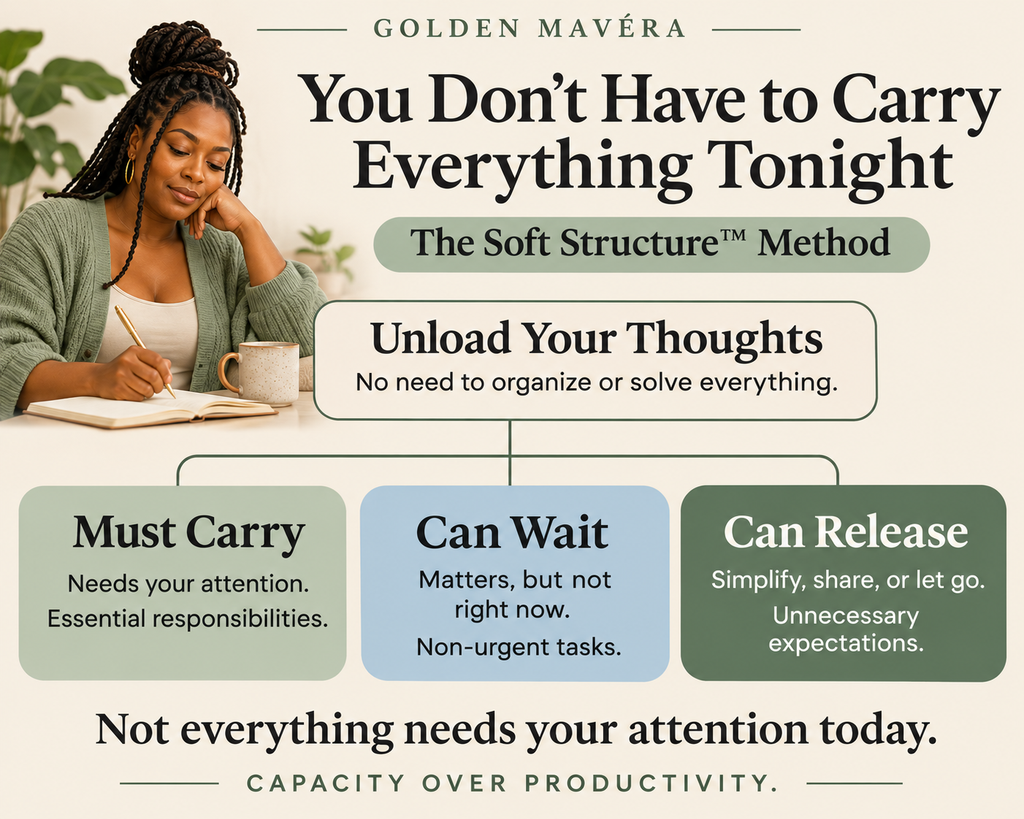
Once you’ve unloaded your thoughts, consider sorting your practical responsibilities into three Soft Structure™ categories.
Must Carry: Responsibilities that genuinely require your attention within the relevant timeframe.
Can Wait: Responsibilities that matter but don’t need to be addressed right now.
Can Release: Responsibilities that could be simplified, delegated, or removed altogether.
Tomorrow’s school lunch may need preparation tonight.
But reorganizing the pantry probably doesn’t.
And if another adult can take full responsibility for scheduling an appointment, you may not need to continue mentally monitoring it.
Where support is limited, focus on realistic opportunities to simplify rather than assuming every responsibility can be delegated.
A gentle pause
Before moving on, ask yourself:
What is one responsibility I’ve been mentally carrying that doesn’t actually need my attention tonight?
You don’t have to resolve it right now. Simply recognizing that it can wait is a meaningful first step.
Create a Gentle Transition Into Your Evening
You don’t need a perfect nighttime routine to give your mind a little breathing room.
Before settling in, you might write down what needs attention tomorrow and check whether anything truly needs to happen tonight.
Then give yourself permission to be finished for the day, even if everything isn’t finished.
Some evenings, that transition might take five minutes. Other evenings, you may not have the energy for it at all.
Your routine should support your life, not become another thing you’re trying to keep up with.
If you struggle with maintaining routines when your circumstances change, explore my guide to building flexible routines that don’t fall apart when life gets busy.
Your capacity can change.
Your plans can too.
Frequently Asked Questions About Mental Rest
Why can’t I relax even when I’m resting?
You may have stopped physically working while remaining mentally engaged with responsibilities, worries, or unfinished decisions.
Mental unloading and reducing unnecessary demands may help create more opportunities for meaningful rest.
Why can’t I switch my brain off at night?
A quiet environment may make thoughts and concerns more noticeable.
However, persistent racing thoughts or difficulty sleeping can have several causes, including stress, anxiety, and underlying health conditions.
If these experiences are ongoing, distressing, or interfering with everyday life, consider speaking with a qualified healthcare or mental health professional.
How can I rest without feeling guilty as a mom?
Begin by recognizing that feeling guilty doesn’t necessarily mean you’re neglecting an important responsibility.
Consider whether something actually requires your immediate attention or whether you’re responding to an expectation that everything must be finished before you rest.
How do I mentally disengage when I can’t reduce my responsibilities?
Not every source of maternal overwhelm is within your control.
Financial pressures, limited childcare, unequal household responsibilities, and workplace demands can make reducing your mental load particularly challenging.
Where possible, externalize reminders, reduce unnecessary decisions, communicate your needs, and explore available support.
Even a small reduction in mental responsibility may be meaningful.
You Don’t Have to Finish Everything to Rest
You may not be able to change every responsibility you’re carrying right now.
But you can begin noticing which ones truly need your attention, which ones can wait, and which ones were never meant to be yours alone.
Mental rest doesn’t require a perfectly organized home, an empty to-do list, or an evening where nothing goes wrong.
Sometimes, it begins with one small decision to stop carrying something that doesn’t need to be handled tonight.
You don’t need to do more. You need a way to carry less.
🌿Your Gentle Next Step
If you’re realizing how much you’ve been carrying mentally, you don’t have to figure out where to begin on your own.
I created The Soft Life Prescription™ as a FREE, 15-minute, AI-guided experience for overwhelmed mothers who need a little room to sort through what’s weighing on them.
You can unload your thoughts without organizing everything first. From there, you’ll receive a personalized reflection and gentle next steps based on your current capacity.
It’s a supportive mental wellness resource, not a substitute for professional mental health care.
Begin your FREE Soft Life Prescription™ mental overload reset.
You deserve a gentler way to end your day, especially when you find yourself asking, “Why won’t my brain turn off?”